
Houston Restaurant Unifies AV, WiFi, and Lighting
A fast-casual Houston restaurant opened with commercial displays, Ubiquiti WiFi, POS, and a Savant control system running the AV and lighting from one touch screen.
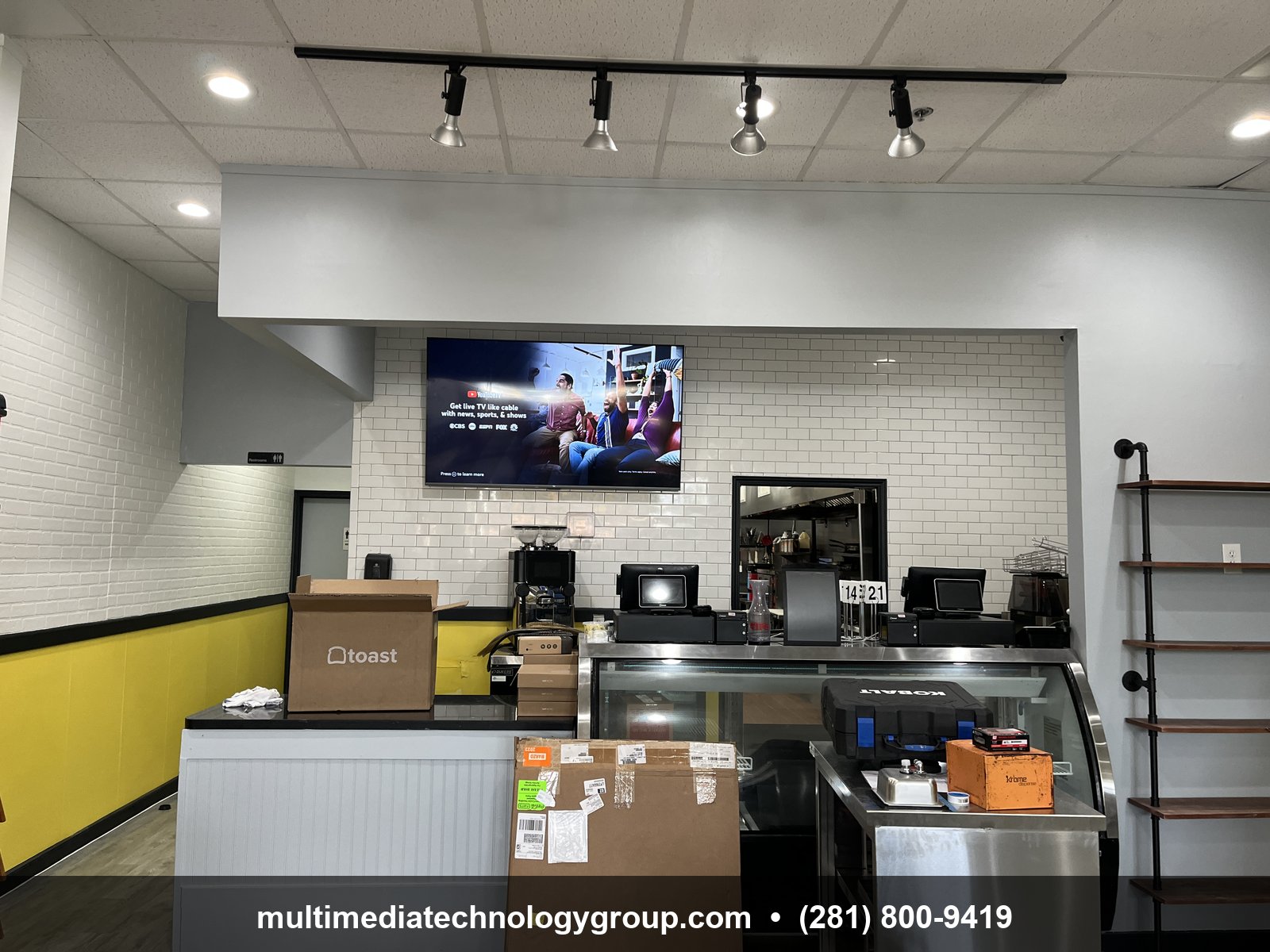
When a Houston restaurant was preparing to open, the owners had one requirement: the space had to be easy to run. We installed the commercial displays, the Ubiquiti WiFi, the network rack, the POS registers, and a Savant control system that runs the AV and lighting from a single touch screen on the wall.
The Client
The client is a fast-casual restaurant opening in Houston. The space includes a dining room, a counter and service area, and a patio. The owners wanted a space that runs smoothly day to day, with menu boards, music, lighting, WiFi, and POS that just work, without needing a technician on site every time something changes.
The Challenge
The restaurant was a blank shell with nothing installed. The owners needed a full technology build-out before opening day, and every piece had to be chosen for how it would hold up under daily restaurant use.
First, the menu boards. The dining room has big front windows, so a consumer TV would wash out in the afternoon sun. The displays had to be commercial-grade, bright enough to stay legible, and built to run from open to close every day.
Second, the network. The restaurant needed guest WiFi for customers, plus a separate, reliable network for the staff, the POS, and the AV. If the POS drops its connection, orders stop, and that cannot happen during a lunch rush.
Third, the point of sale. The cash registers had to be wired, tested, and fast, because checkout speed is the difference between a smooth rush and a line out the door.
Finally, the control. Music and lighting had to be simple enough that a shift lead could run them without a training manual. The owners did not want three remotes, a row of unlabeled switches, and a binder of instructions. They wanted one screen that does everything.
The Solution
We designed and installed the full system before the restaurant opened.
For the menu boards, we installed commercial displays. These are built for all-day operation and high brightness, so the menus stay legible even with sunlight coming through the front windows. They are also rated for the long hours a restaurant keeps.
For the network, we installed Ubiquiti access points and built a managed network with two separated networks: a guest network for customers and a private network for staff, the POS, and the AV. The whole thing lives in a wall-mounted rack that we built and labeled, so the router, switch, and cabling sit in one clean place instead of scattered under a counter.
For the point of sale, we wired the cash registers onto the private network and tested every register before opening day. Wired POS means a register never loses its connection mid-order, which is exactly the kind of failure that shows up at the worst possible time.
The centerpiece is a Savant control system. A single touch screen mounted on the wall controls the AV and the lighting. From that one screen, a manager can play music, change the volume, turn on the patio lights, or set a dinner scene, all in a few taps. No separate remotes, no wall switches scattered around, no guesswork.
Technology Deployed
- Commercial menu board displays
- Ubiquiti access points
- Network rack with router, switch, and labeled cabling
- Wired POS cash registers
- Savant control system with a wall-mounted touch screen
- Lighting control integrated into Savant
The Results
Opening day came and went without a technology hiccup.
The menu boards were bright and readable from open to close. The guest WiFi handled a full dining room without complaints. The POS never dropped a transaction. And the staff picked up the Savant touch screen in minutes, because everything they needed was on one screen.
The owners got what they asked for: a space that is easy to run. The shift lead turns on the lights, starts the music, and opens the registers from one place. When the dinner rush starts, no one is thinking about the technology.
Because the network and AV live in a labeled rack, future maintenance is predictable. If something needs attention, the owners can point us to the exact device in the rack instead of describing a mystery box under a counter.
The Process
The project followed the same shape as every rollout. We walked the space before construction finished, marked where the displays, access points, rack, and touch screen would go, and ran the cabling while the walls were still open. That pre-wiring is the quiet part of the job that saves the most pain later.
We built the rack off-site, labeled every cable, and mounted it in a clean, reachable location. Then we installed the displays, the access points, the POS, and the Savant system, and commissioned everything against a checklist.
The last step was training. We walked the owners and the shift leads through the Savant touch screen, showed them how to change music, adjust lighting, and check the network, and left a one-page guide in the back office.
Why Savant for Control
We chose Savant for the control layer because it is built for exactly this kind of space. A restaurant does not need a rack of knobs. It needs one screen where the music and the lights live. Savant lets us put that screen on the wall, give it big, obvious controls, and lock down everything the staff should not touch.
The owners get the power of a full control system, and the staff gets a screen that is hard to get wrong. That is the right trade-off for a business where the person running the AV during the dinner rush is also running the floor.
Security and Guest WiFi
For a restaurant, the guest WiFi is part of the customer experience, but it cannot touch the systems that run the business. We separated the two networks from day one. Customers join the guest network, which is isolated from the POS and the AV. The private network carries the registers, the displays, and the control system, and it is password-protected and managed.
That separation is what keeps a customer's phone from ever reaching a cash register, and it keeps payment data and operations traffic off the guest network. It is the kind of thing that never gets noticed when it works, and never gets forgiven when it does not.
Beyond the Dining Room
The same backbone extends beyond the dining room. The patio got its own lighting zone in the Savant system, so the staff can set the outside lights separately from the dining room. The access points cover the patio too, so customers stay connected outside.
When the owners are ready to add a second location, they have a template they can repeat, from the menu boards to the touch screen. They already know exactly what worked, and they can roll the same setup out again without starting from scratch.
Why It Worked
The project worked because everything was designed as one system, not a pile of gadgets. The displays, the WiFi, the rack, the POS, and the Savant control all share one network and one design. When a restaurant's technology is that integrated, it is easy to run, and that is exactly what the owners wanted.
The other factor was simplicity for the end user. A Savant touch screen is powerful under the hood, but on the wall it is just a clean screen with big, obvious buttons. The staff did not need to learn AV or networking. They needed to learn one screen, and they did, in minutes.
The bottom line for the owners is simple. They do not think about their technology during a rush, and that was always the goal. When a Houston restaurant can open the registers, start the music, and set the lights from one screen, the system has done its job.
The takeaway from this project is straightforward. A restaurant's technology should support the staff, not demand their attention. The commercial displays, the Ubiquiti network, the rack, the POS, and the Savant control all exist for one reason: to let the owners run the restaurant and forget the equipment exists. When the lunch rush hits and the line is out the door, nobody should be thinking about the WiFi or the menu board. They should be thinking about the food and the customers.
That is what an integrated system buys you. One network, one rack, one touch screen, and a staff that can run it without a manual. If you are planning a restaurant or retail build-out, the time to get the technology right is before opening day, not after the first busy weekend.
Listen to this case study
Watch the video